You’ve just committed to hosting fourteen people for a supper-club opener. The centerpiece is a charcuterie board — a spread of cured and preserved meats (think sliced salami, paper-thin prosciutto, pâté) alongside aged cheeses, pickles, and a few pantry anchors. It looks generous in your head. Then you start doing the actual math and realize you have no reliable number for how much to buy, and a vague suspicion that your two existing boards might not be large enough to hold it all without looking like a game of Tetris. Both problems are solvable. This guide walks through the portioning math first — ounces per guest, role of the board (starter vs. main event), and how protein fatigue changes your numbers — then moves to surface selection: what board materials, dimensions, and construction details actually matter when the load is real and the guests are paying attention.
The Portioning Math, Laid Out Plainly
The foundational numbers come from a fairly stable industry consensus. Serious Eats’ guide to building a charcuterie board, Food & Wine’s cheese-board framework, and Epicurious’ party-quantity overview all land within the same range — with modest variation based on meal role.
By the numbers:
| Board’s role in the meal | Cured meat per guest | Cheese per guest | Total protein load |
|---|---|---|---|
| Passed appetizer (pre-dinner) | 1–1.5 oz | 1–1.5 oz | 2–3 oz |
| Dedicated starter course | 2–2.5 oz | 2–2.5 oz | 4–5 oz |
| Main event / light dinner | 3–4 oz | 3–4 oz | 6–8 oz |
Those are your working baselines. Now here’s where intermediate practitioners tend to miscalculate: the blend of SKUs (individual products you’re selecting) compresses apparent portion sizes. A board with four charcuterie items and four cheeses looks more abundant than one with two of each, even at identical total ounces. This is not a trick — it’s how appetite and grazing psychology work. Bon Appétit’s overview of cured meats makes this explicit: variety signals generosity more reliably than volume does. So when you’re ordering, you can often hold total protein weight steady and add SKUs by reducing per-item quantities.
The Format Factor
Not all charcuterie formats eat the same way, which changes your effective ounces. A whole-muscle cut like La Quercia’s Prosciutto Americano or Fra’Mani’s Cotto is sliced thin and picked up one or two slices at a time — guests self-regulate naturally, and a 2 oz nominal portion feels substantial. A spreadable format like a mousse or pâté disappears at two to three times the speed of sliced meat, especially if good bread is adjacent. Saveur’s guide to French charcuterie traditions notes that rillettes (a slow-cooked, shredded pork fat preparation spreadable like butter) and pâté portions should be calculated at 1.5× the weight of their sliced equivalents because utilization rates are higher and portion self-discipline collapses at the board.
Practical adjustment: If your board includes one spreadable item, add 20–30% to your total charcuterie weight. If it includes two spreadables, buy as if you have one additional guest at the table.
Cheese Selection and Weight Distribution
Cheese math has its own wrinkle. Per Food & Wine’s cheese-board guidance, the standard planning ratio is one-third of total cheese weight in a soft or fresh format (like a young chèvre or a fresh burrata, if you’re blending styles), one-third in a semi-firm aged format (a Manchego, a Comté, an aged Cheddar), and one-third in a bold or blue format (Jasper Hill Bayley Hazen Blue, or a Roquefort-style import). That distribution ensures textural contrast and also means the bold formats, which guests eat in smaller bites, aren’t carrying a disproportionate cost burden.
For 14 guests at the dedicated starter course level (2.5 oz cheese per person): you need approximately 35 oz, or just under 2.2 lbs of cheese total. Split into thirds across three styles, you’re buying roughly 11–12 oz of each — which maps cleanly to common retail wedge sizes ($18–$28 each at most artisan cheese counters or a service like Murray’s or Jasper Hill direct).
Board Sizing: Where the Math Meets the Surface
Here’s the disconnect that catches people: portioning math tells you how much to buy; it doesn’t automatically tell you what surface can hold it. The two calculations are independent and both need to happen.
Surface Area, Not Board Count
The reliable planning unit is square inches of usable board surface, not number of boards. A 24-inch round board sounds impressive but its usable area (for a perfect circle) is only ~452 sq in — and the edges taper, so realistic usable space is closer to 380–400 sq in once you account for border clearance. A 12×24-inch rectangular board gives you 288 sq in but with near-100% utilization because the corners and edges are all workable.
The working rule cited by operators and caterers across aggregated reviews: plan for approximately 12–15 square inches of board surface per ounce of total plated product (meats + cheeses combined, before accompaniments). This accounts for visual spacing, accompaniment clusters (cornichons, honeycomb, mustard ramekins), and the open negative space that keeps a board from looking like a warehouse shelf.
For 14 guests at starter-course portions (4–5 oz total per guest = 56–70 oz combined): you need 672–1,050 square inches of working surface. That’s not one board. That’s almost certainly three boards minimum, or two large boards plus a smaller satellite for accompaniments.
Material Tradeoffs at Real Scale
When the load is heavy and the service window is extended (a two-hour cocktail party, a supper club where the board is replenished twice), material choice becomes a real decision, not an aesthetic one.
End-grain hardwood boards (walnut, maple, cherry) are the consensus recommendation across operators who run boards at volume. The end-grain construction — where the wood fibers face upward rather than sideways — is more resistant to the scoring that accumulates when guests cut directly on the surface. Owners consistently report that end-grain boards at the 20×28-inch range hold up to sustained knife contact better than edge-grain alternatives at the same price point. The trade: they’re heavier (often 8–14 lbs for a large format), they require periodic oiling with food-safe mineral oil to prevent cracking, and they command a significant price premium — well-constructed end-grain boards from brands like BoardSmith or Virginia Boys Kitchens run $120–$280 at that scale.
Edge-grain boards (the more common construction, where the wood’s long face is the surface) are lighter, somewhat less expensive, and still entirely serviceable for home entertaining. The limitation shows up over time and at higher temperatures — extended service in warm rooms with high-acid accompaniments (pickles, citrus) can raise the grain and leave scoring marks more visibly. For supper-club operators running boards weekly, the replacement cycle is meaningfully shorter.
Slate and marble are visually striking and genuinely useful as secondary surfaces for cheese-only stations — they stay cool, which matters for soft cheeses and fresh formats, and they don’t absorb fat or odor. Epicurious’ party-planning coverage notes slate’s durability advantage for transport. The limitation is obvious: they’re heavy, they chip at edges under real kitchen conditions, and they’re unforgiving if a board is stacked against a walnut edge. Reserve them for dedicated cheese courses or centerpiece single-board moments rather than as your primary working surface.
Composite and acrylic boards (often marketed as “food-safe resin” or “recycled material” formats) are increasingly common in the $40–$90 range. Reviewers in long-run assessments note they’re dishwasher-safe and non-porous (no fat absorption, no odor retention), which is a genuine advantage in commercial or high-turnover settings. The honest tradeoff: they look like what they are. If the visual presentation of your board is a signal to guests about your sourcing standards — which it often is, in a supper-club context — a composite board undercuts that message in ways a well-oiled walnut surface does not.
Board Sets vs. Individual Boards: The Sourcing Decision
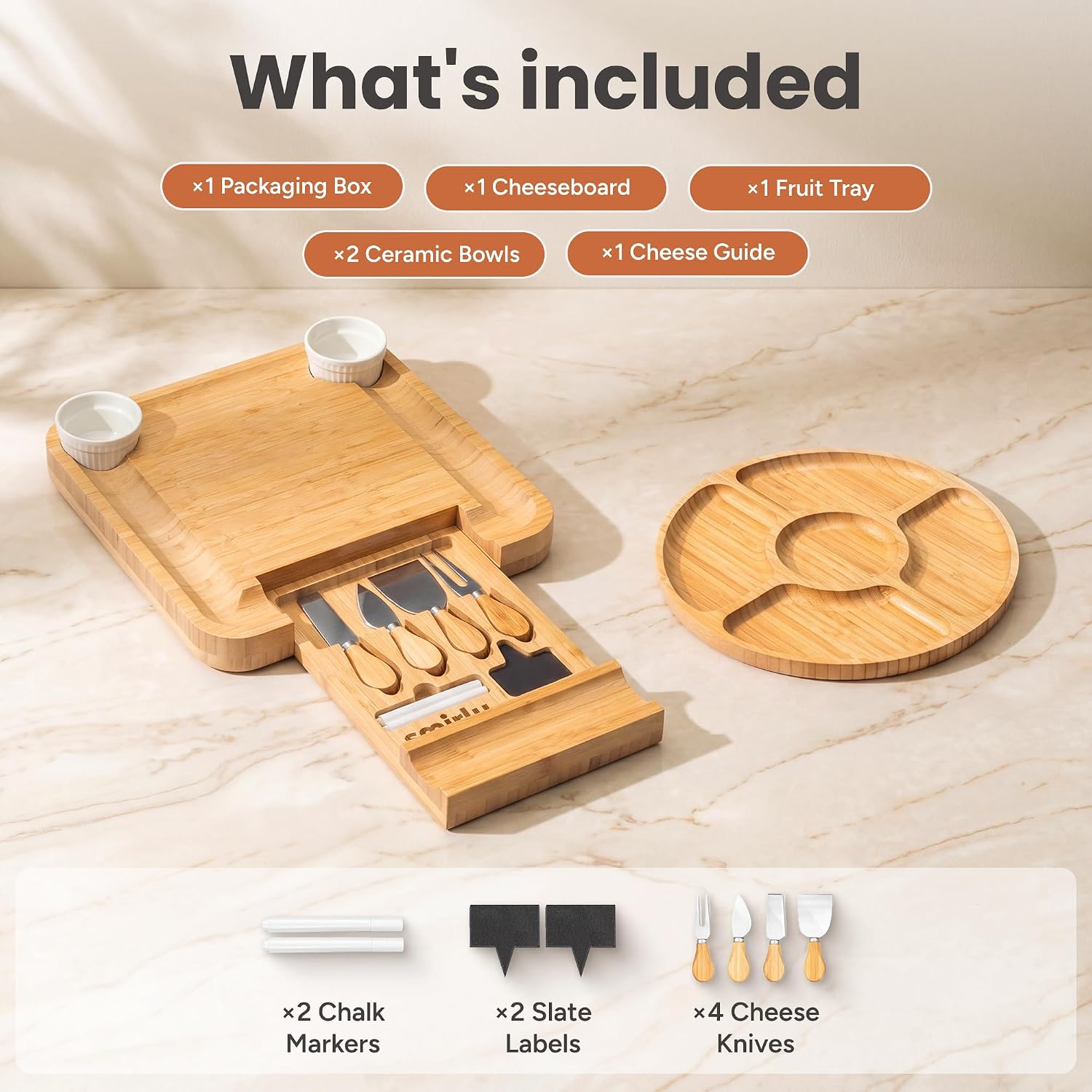
Board sets — typically a large primary board plus one or two smaller satellites — are marketed on convenience but should be evaluated on a different criterion: dimensional compatibility and total surface coverage. A set with a 20-inch round primary and two 8-inch rounds sounds like coverage, but the total usable area is still under 500 sq in. That works for eight guests at appetizer portions. It does not work for fourteen at a dedicated starter course.
The practitioners who run boards consistently have landed on a more modular approach: one or two large-format primary boards (20×28 inches or larger in rectangular, or 22-inch-plus in round) plus a collection of individual small satellite boards (8–12 inch rounds or squares) for overflow and replenishment staging. This gives you flexibility to replenish without disturbing the primary presentation, and it lets you differentiate sections — one satellite for spreadables and bread, one for accompaniments — which actually helps guests navigate the spread.
The cost-per-use math favors buying fewer, better large boards over sets. A $240 end-grain walnut board used forty times per year across events amortizes to $6 per use. A $90 board set that needs replacement after 18 months of weekly use costs more per event by month fifteen.
The Decision Framework
If you’re sourcing for a one-time dinner party with eight or fewer guests at starter-course portions, a single quality 20×24-inch edge-grain or end-grain board is sufficient, and a mid-range board in the $80–$140 range from a maker like Teakhaus or BoardSmith handles the load.
If you’re running a supper club, catering boards for twenty-plus, or replenishing across a multi-hour event, surface coverage is the constraint. Build toward 600+ square inches of total working surface across modular boards, prioritize end-grain construction for your primary surface, and treat satellite boards as a separate category (where slate or lighter edge-grain are fine, because they’re not carrying knife traffic).
On portioning: commit to your meal-role category before you shop. Starter course (2–2.5 oz meat, 2–2.5 oz cheese per guest) is the most common miscalculation zone — people buy at appetizer weights but stage the board as a dedicated course, and the board runs out in forty minutes. If the board is the event, buy at main-event weights. Per Saveur’s French charcuterie framing: the board that looks almost too generous at setup is exactly right at service.
The math is not glamorous. The result — a board that holds its presentation through the full service window and leaves no guest calculating whether there’s enough left for them — is.