You’re at the farmers’ market and you pick up a small tin of finishing salt — finishing salt meaning salt that gets added at the end of cooking, right before serving, not during. It’s meant to be tasted, not dissolved. The vendor says it’s “harvested by hand in Brittany” and costs $14 for two ounces. You buy it, you sprinkle it on a fried egg, and something genuinely good happens. Then you go home and find four other salts in your cabinet that all say “finishing” on the label, and you wonder: are they interchangeable? The honest answer is no — not quite. Different salts have different crystal shapes, different moisture levels, and subtly different mineral makeups, all of which affect the way they land on food. This guide walks through six of the most widely available and discussed finishing salts, explains what actually differs between them, and tells you which foods each one serves best. By the end, you’ll have a clear decision rule for stocking one, two, or three of them without redundancy.
What “Mineral Profile” Actually Means — and How Much It Matters
Let’s be precise about this because the marketing around finishing salt tends to be romantic to the point of misleading. All food-grade salt is predominantly sodium chloride — typically 97–99.9% of it, depending on the source and processing method. The remaining fraction is trace minerals: magnesium, calcium, potassium, sulfates, and in some sea salts, iodine that hasn’t been added artificially. That trace fraction is real, and it does contribute to flavor — mostly as a subtle modifier of bitterness, sweetness, and sharpness rather than as a distinct “flavor” of its own.
Saveur’s guide to salt puts it plainly: the mineral differences between premium finishing salts are real but modest. What accounts for most of the perceptible difference between, say, Maldon and fleur de sel is crystal structure — the size, shape, and density of the flake, which determines how quickly it dissolves on your tongue and how much crunch it delivers. A wide, thin flake dissolves in a single burst. A dense crystal crunches and then releases more slowly. That difference in texture is where these salts genuinely diverge from one another, and it matters enormously for use-case pairing.
The Six Salts: Structure, Mineral Character, and Best Use
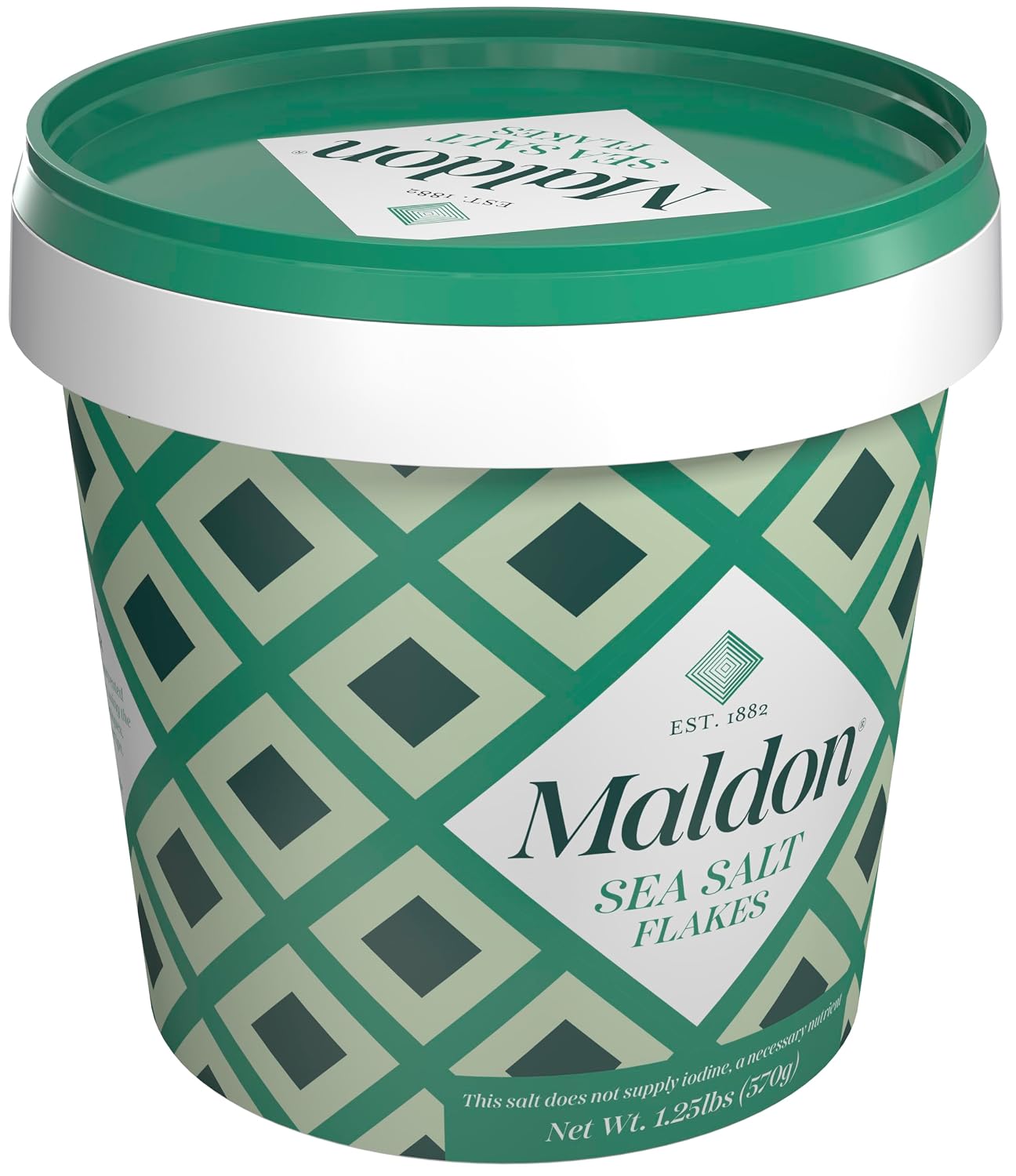
1. Maldon Sea Salt Flakes (Essex, England)
Crystal structure: Large, hollow, pyramid-shaped flakes. These are the result of a slow evaporation process in open pans, which pulls crystals upward into their distinctive hollow pyramid form. They’re light and brittle — they shatter when you crumble them between your fingers.
Mineral character: Very clean. Maldon is raked from shallow pans in a tidal estuary, then lightly processed, leaving a straightforward salinity with minimal bitterness. Cook’s Illustrated’s tasting notes describe it as “pure and clean” with no off-notes.
Best pairings: Anywhere you want visible flake and a clean, non-competing salt hit. Chocolate chip cookies (press a few flakes into the top before baking), roasted vegetables, avocado toast, and grilled fish where you want salt punctuation rather than mineral complexity. Maldon is the reliable workhorse of finishing salts — it does almost everything acceptably, which also means it does nothing with exceptional specificity.
Skip it if: You’re finishing a briny or acidic dish (oysters, ceviche, a sharp vinaigrette-dressed salad) where you actually want mineral complexity and structure to push back against the acid. Maldon’s clean profile can read as flat here.
2. Fleur de Sel (Guérande, France)
Crystal structure: Small, irregular, moist clusters. Fleur de sel — which translates literally as “flower of salt” — is the thin crust that forms on the surface of salt pans in Guérande during warm, dry weather. It’s harvested by hand with a wooden rake (a lousse) and never dried. That residual moisture is intentional.
Mineral character: Distinctly higher in magnesium chloride than most finishing salts, which contributes a subtle briny, almost oceanic bitterness and a slightly softer, rounder salinity compared to Maldon. Serious Eats describes the taste as “gently briny with a complex mineral finish.”
Best pairings: Butter-poached or sautéed proteins (scallops, chicken breast, duck), soft cheeses like fresh chèvre or burrata, and egg dishes where you want salt that integrates rather than punctuates. The moist crystal clings to food surfaces and begins dissolving slightly on contact, which creates a more cohesive effect than a hollow Maldon flake.
Skip it if: You’re using it over something where crunch is the point — a thick steak crust, crunchy roasted potatoes. The moisture and smaller crystal size mean fleur de sel doesn’t deliver the satisfying snap that a larger, drier flake provides.
Price note: Authentic Guérande fleur de sel (look for the IGP certification on the label) runs $12–$22 for 4.4 oz from specialty importers. Knockoffs from non-Breton regions are common; the IGP mark matters here the way an AOC matters on Champagne.
3. Jacobsen Salt Co. Pure Flake (Netarts Bay, Oregon)
Crystal structure: Medium to large, irregularly pyramidal flakes that land somewhere between Maldon’s hollow delicacy and fleur de sel’s damp cluster. Jacobsen harvests from Oregon’s Netarts Bay by drawing in Pacific seawater and evaporating it over low heat indoors.
Mineral character: Bon Appétit’s explainer notes that Pacific-harvested salts tend to carry higher sulfate and magnesium content than Atlantic salts, contributing a slightly sharper edge and a long mineral finish. Jacobsen flake has a cleaner, crisper bite than fleur de sel with slightly more complexity than Maldon.
Best pairings: Raw applications — sliced radishes, butter boards, crudités, sashimi — where you want the salt to read clearly alongside clean, unfussy flavors. Also performs well as a finishing salt on dark chocolate and caramel, where that Pacific minerality creates contrast. Jacobsen’s association with the Pacific Northwest locavore pantry makes it a natural fit on cheese boards for American-produced charcuterie and aged raw-milk cheeses.
Skip it if: You need your salt to completely disappear into a composed bite. The Pacific minerality is noticeable and assertive enough that delicate preparations (a light sole meunière, a fresh ricotta crostini) can be overwhelmed.
4. Sel Gris / Grey Salt (Celtic Sea Salt, France)
Crystal structure: Moist, coarse, grey-tinted crystals. Sel gris is the denser salt that settles to the bottom of the same salt pans that produce fleur de sel — it’s harvested separately from the bottom of the pan rather than skimmed from the surface, and it picks up clay minerals from the pan floor in the process.
Mineral character: The highest mineral complexity of any salt in this comparison. The clay contact adds iron, magnesium, and trace silicates. Food & Wine’s finishing salt feature describes sel gris as “earthy, savory, and assertively mineral” — this is a salt with a point of view.
Best pairings: Bold foods that can absorb mineral complexity — grilled red meat, lamb, roasted beets, dark roasted mushrooms, and oily fish like mackerel or sardines. Sel gris is also the correct salt for finishing hearty lentil or bean dishes (Rancho Gordo’s Rio Zape heirloom beans, finished with sel gris before serving, is a legitimately excellent combination). Its weight and moisture mean it adheres well to meaty surfaces.
Skip it if: Delicate or sweet applications. The earthiness will compete in a way that tastes muddy rather than complex.
5. Himalayan Pink Salt (Pakistan)
Crystal structure: Dense, hard crystals that require grinding or pre-crumbling. Sold in various grades; the finishing-appropriate form is a fine-ground or pre-crumbled version, not the coarse chunks meant for grinders.
Mineral character: The pink color comes from trace iron oxide. The overall mineral profile is actually quite mild — arguably the least complex of the six salts here. Cook’s Illustrated notes that in blind tastings, Himalayan pink salt is frequently indistinguishable from standard table salt when dissolved in water. Its minerality is primarily visual.
Best pairings: Aesthetically driven applications — Instagram-friendly dishes, presentations where the pink color is part of the point, salt rims on specialty drinks. As a functional finishing salt, its value proposition is primarily cosmetic.
Honest verdict: The premium pricing on Himalayan pink salt (often $8–$15 for the same quantity as cheaper alternatives) is mostly a story, not a flavor. For a practitioner building a functional pantry, this one is optional at best. Keep it for presentations where the visual matters; don’t prioritize it over fleur de sel or Jacobsen for flavor-forward applications.
6. Flor de Sal (Algarve, Portugal / Ibiza, Spain)
Crystal structure: Similar to fleur de sel — thin, moist surface crystals harvested by hand — but produced in the warmer Mediterranean and Iberian Atlantic climates, which tends to create slightly larger, drier flakes than Guérande.
Mineral character: The warmer evaporation environment produces a cleaner, less earthy profile than Guérande fleur de sel. The Iberian versions in particular are noted by Saveur’s guide as having a lighter, more purely briny character with less of the magnesium-driven bitterness.
Best pairings: A slightly more versatile alternative to Guérande fleur de sel — the lighter profile makes it work across both savory (grilled seafood, vegetable salads, fresh mozzarella) and sweet applications (shortbread, toffee, stone fruit). The Ibiza-sourced versions have developed a following among pastry-focused chefs for exactly this reason.
Price note: Flor de Sal d’Es Trenc from Ibiza runs approximately $15–$24 for 4.4 oz from specialty importers as of mid-2026 — comparable to Guérande fleur de sel at similar weights.
By the Numbers
| Salt | Crystal Type | Relative Mineral Complexity | Approx. Price / 4.4 oz | Best Single Use |
|---|---|---|---|---|
| Maldon | Hollow pyramid | Low | $8–$10 | Chocolate, cookies, roast veg |
| Fleur de Sel (Guérande) | Moist cluster | Medium-high | $12–$22 | Butter, scallops, soft cheese |
| Jacobsen Pure Flake | Medium pyramid | Medium | $14–$18 | Raw veg, sashimi, chocolate |
| Sel Gris | Dense, moist coarse | High | $10–$14 | Red meat, lamb, beans |
| Himalayan Pink | Dense, hard crystal | Low | $8–$15 | Visual/aesthetic applications |
| Flor de Sal (Iberian) | Thin, slightly drier cluster | Medium | $15–$24 | Pastry, seafood, fruit |
The Decision Rule: Which Salts to Stock
If you’re building from nothing and want maximum coverage with minimum redundancy: Maldon plus fleur de sel covers roughly 80% of everyday finishing scenarios. Maldon handles crunch-forward and clean-profile applications; fleur de sel handles integrated, moisture-sensitive, and butter-adjacent applications.
If you’re adding a third salt for range: Sel gris extends your coverage into bold, protein-forward territory where the other two feel thin.
If you’re sourcing for a cheese board or American-pantry narrative specifically: swap Jacobsen in for Maldon. The Pacific minerality reads as intentional and interesting in that context in a way that Maldon’s neutrality doesn’t.
Skip the Himalayan pink for flavor work. It belongs in presentations, not in the serious finishing rotation. Buy it for the color; don’t pay premium prices expecting premium mineral complexity that isn’t there.
The final rule is simple: if the food is delicate, use the lightest crystal. If the food is bold, use the most mineral-forward salt. If you want visible, satisfying crunch, use a large, dry flake. Match weight to weight, and these salts stop being interchangeable — and start being genuinely useful tools.