Picture this: you’re finishing a composed salad — roasted beets, a wedge of chèvre, a drizzle of good olive oil — and you reach for your finishing salt. You pinch a few crystals from a small ceramic cellar, scatter them across the plate, and they dissolve into something that tastes unmistakably complete. That salt almost certainly wasn’t table salt. It was probably fleur de sel — French for “flower of salt” — the thin, delicate crust that forms on the surface of shallow saltwater ponds when wind and sun combine at exactly the right moment. Unlike ordinary salt, which is mined or heavily refined, fleur de sel is hand-harvested by workers called paludiers using flat wooden rakes, and it’s collected only in warm, dry weather. The result is a moist, irregular crystal with a mineral complexity that table salt simply cannot approximate.
Here’s the problem: “fleur de sel” has become a prestige label, and producers around the world now apply it to finishing salts of wildly different character, origin, and price. If you’re sourcing salt for a cheese board service, a supper club, or a serious pantry, the decision between a $12 tin from Guérande and a $28 jar from the Algarve is not just a budget call — it’s a flavor and use-case call. This guide breaks down four primary harvesting regions, names the tradeoffs explicitly, and gives you a clear decision rule at the end.
Why Provenance Actually Changes the Salt
Salt seems like the most generic ingredient imaginable. It’s sodium chloride. But fleur de sel’s flavor is shaped by factors that vary enormously by geography: the mineral content of the underlying clay or rock, the salinity of the water source, the humidity and wind patterns during harvest, and even the microorganisms present in the evaporation ponds.
Saveur’s reporting on French salt traditions notes that the pale grey color of Breton fleur de sel comes partly from mineral-rich clay in the pond floors — clay that leaches trace amounts of magnesium, calcium, and potassium into the brine. Those minerals aren’t just marketing language; they’re detectable on the palate as a faint brininess, a slight “ocean” quality that persists after the sodium hit fades. A salt harvested from volcanic basalt beds in Portugal will carry different mineral echoes entirely.
Moisture content also varies. Fleur de sel is intentionally not dried — that moisture is part of the product. But the degree of retained moisture affects how the crystal clings to food, how quickly it dissolves, and how long it keeps without caking. Serious Eats’ finishing salt guide notes that very high-moisture salts require more careful storage and have shorter practical shelf lives, which matters if you’re buying in volume for a catering operation.
The practical upshot: regional origin predicts flavor profile, texture, and appropriate use case. Here’s how four major sources stack up.
The Four Regions, Compared
Guérande, Brittany (France) — The Benchmark
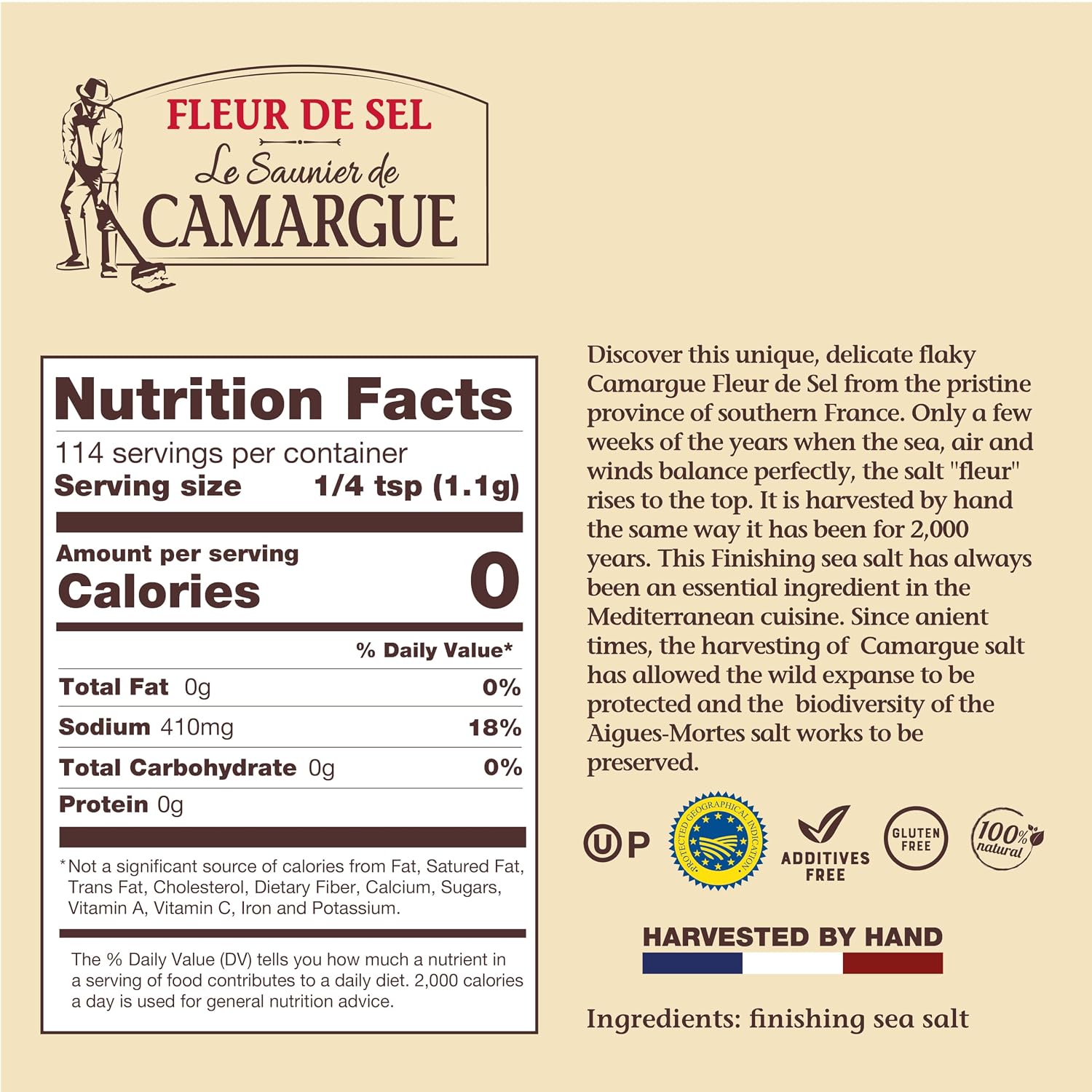
Guérande is the origin that gave fleur de sel its global reputation. The salt marshes here are ancient — some ponds date to the ninth century — and they’re managed under a cooperative system. The Sel de Guérande label carries an IGP designation, a European geographic protection that functions like an appellation for salt. Paludiers harvest only during summer months when Atlantic winds dry the surface of the brine ponds and the fragile crust forms.
Flavor profile: noticeably moist crystals, a lingering mineral complexity with a mild oceanic finish, lower bitterness than many competitors. The texture is irregular and relatively large-flaked compared to other producing regions, which makes it excellent for tableside finishing on meat, fish, and simply dressed vegetables. Food & Wine’s ranked finishing salt overview consistently places Guérande-origin fleur de sel at the top of blind tastings for balance and versatility.
Price range (as of May 2026): expect to pay $12–$18 for 100–125g from a reputable importer. Le Paludier and La Baleine both produce widely distributed IGP-certified product. The IGP certification requires hand-harvesting by certified paludiers and prohibits mechanical processing — currently the strongest documentary assurance available in this category.
Sea
$25.99
In stock on Amazon
Check price on AmazonÎle de Ré, France — The Crisper Alternative
Île de Ré is a small Atlantic island off the French coast, roughly an hour from La Rochelle. Its salt marshes operate under the same hand-harvest tradition as Guérande but yield a perceptibly different product. The island’s sandier substrate — less clay than the Guérande marshes — produces fleur de sel with lower mineral pickup and a cleaner, crisper salinity. Many producers and chefs describe it as “purer” tasting, though that framing depends entirely on what you’re looking for.
Moisture content trends slightly lower than Guérande, which makes Île de Ré fleur de sel easier to store in humid environments and gives it a marginally longer workable pantry life. The crystal structure tends to be slightly finer. Saveur describes the profile as leaning cleaner and more restrained than its Breton counterpart — which is either a selling point or a drawback depending on your application.
Price range: typically $15–$22 for comparable weights, reflecting lower overall production volume. The island’s production is smaller than Guérande’s and the salt carries a boutique premium. Unlike Guérande’s IGP, Île de Ré salt relies on producer-level certification rather than a pan-regional regulatory designation, so importer vetting matters more here.
Le
$11.90
In stock on Amazon
Check price on AmazonAlgarve, Portugal — The Value Challenger
Portugal’s Algarve coast has been producing sea salt for centuries, and in the last decade, artisan producers there have begun marketing their product explicitly as fleur de sel, competing directly with French imports in the North American specialty market. The Ria Formosa natural park, a lagoon system on the southern coast, is the primary harvesting zone.
Algarve fleur de sel tends toward larger, drier crystals than its French counterparts. The flavor is bold — higher perceived sodium intensity, a more pronounced brine note, less of the subtle mineral finish that defines Guérande. Some buyers find this directness appealing; others miss the complexity. Food & Wine’s tasting notes on Portuguese finishing salts describe the profile as assertive and oceanic, which is accurate and useful shorthand for matching it to the right application.
The practical argument for Algarve sourcing is price. At $10–$14 for 100g in comparable packaging, it’s the most accessible entry point in the fleur de sel tier — meaningful if you’re buying quantities for catering service or want a daily-driver finishing salt that’s better than grocery-store kosher but doesn’t command a premium on every pinch. Unlike French IGP-certified product, the Algarve category has no single overarching regional designation; quality varies by producer, and direct importer relationships or published harvest documentation are the best available proxies for consistency.
Straight
$5.99
In stock on Amazon
Check price on AmazonSicily, Italy — The Wildcard
Sicilian fleur de sel (sometimes labeled fior di sale in Italian) comes primarily from the salt pans near Trapani, on the island’s western tip. This is windmill country — the ancient windmills that once powered the salt works are now protected landmarks — and the production tradition is distinct from Atlantic harvesting. The Mediterranean environment means longer evaporation seasons, different wind patterns, and water with a different mineral profile than the Atlantic.
The result is a fleur de sel with a distinctly drier texture, pronounced whiteness (the Mediterranean substrate is largely limestone, contributing less of the grey mineral tint common in Breton salt), and a flavor that’s clean and intensely saline without much of the “marine” character of Atlantic salts. Serious Eats’ finishing salt coverage notes that Sicilian sea salts in general tend toward a sharp initial salinity that fades cleanly, with very little aftertaste — a profile that works particularly well where you want salt presence without a lingering mineral note.
Price range: highly variable. Trapani salts marketed as fior di sale range from $9 to $25 depending on the producer and importer. Epicurious’s guide to salt types flags that the fior di sale designation is less regulated than French IGP-certified product, which means quality is inconsistent and producer vetting is essential before buying in volume.
Le
$11.90
In stock on Amazon
Check price on AmazonBy the Numbers
| Region | Crystal Size | Moisture | Mineral Complexity | Approx. Price / 100g | Regulatory Designation |
|---|---|---|---|---|---|
| Guérande, Brittany | Large, irregular | High | High | $12–$18 | IGP-certified |
| Île de Ré, France | Medium-fine | Medium | Medium | $15–$22 | Producer-certified |
| Algarve, Portugal | Large, dry | Low–medium | Medium-high | $10–$14 | Varies by producer |
| Trapani, Sicily | Fine-medium | Low | Low–medium | $9–$25 | Unregulated |
Prices reflect May 2026 North American specialty retail. Weights are approximate; packaging varies by producer.
What the Label Won’t Tell You — and Should
The single biggest sourcing trap in this category is confusing “sea salt” with “fleur de sel.” True fleur de sel is surface-harvested, not raked from the pond floor (that’s sel gris — grey salt — a related but different product). Many products labeled “fleur de sel” are actually blended or mechanically harvested. The IGP designation on Guérande product is currently the strongest documentary assurance available in this category; it requires hand-harvesting by certified paludiers and prohibits mechanical processing.
For Île de Ré, Algarve, and Sicilian products, you’re relying on producer reputation and importer vetting. Worth asking: Does the importer visit the production site? Is the harvest year documented anywhere on the packaging? Moist salt degrades faster than dry salt, so a dated harvest tin is meaningfully more useful than undated stock that’s been sitting in a distributor warehouse for an unknown period.
Epicurious’s overview of salt types makes a practical point that applies here: specialty salt buyers tend to over-index on origin story and under-index on freshness. A 2024-harvest Guérande tin in good storage beats a three-year-old tin of the same product — and no amount of regional prestige compensates for salt that has dried out, caked, or absorbed ambient odors.
When evaluating any specialty salt vendor, look for lot-level provenance notes as a baseline quality signal. Producers who publish harvest documentation — including year, harvest conditions, and paludier certification — are making verifiable claims. Producers who don’t are asking you to take marketing copy on faith.
The Decision Rule
If you’re building a single pantry staple and want maximum versatility, Guérande IGP is the correct default. The mineral complexity, the texture, and the regulatory guarantee justify the price premium for most applications.
If you’re running a catering operation or supper club where salt volume is meaningful and you need a daily-driver finishing salt for bold, high-heat preparations, Algarve is the honest value play. It performs at a level most guests won’t distinguish from Guérande on a grilled vegetable or seared protein.
If you’re sourcing for delicate composed plates — raw seafood, fresh dairy, light vinaigrettes — Île de Ré’s cleaner profile earns its boutique premium, and the lower moisture content is a practical benefit in professional kitchen environments.
If you’re finishing baked goods, chocolate, or Italian-style pasta dishes and want sharp salinity without mineral interference, Sicilian fior di sale is the correct tool — but vet the producer carefully, because the category has no meaningful regulatory floor.
The short version: know the application first, then match the region. Fleur de sel isn’t interchangeable across its four major sources, and the $6–$10 price spread between them is not the most important variable. Flavor architecture is.